Lilium occidentale
Purdy 1897
Western lily

lilium occidentale (Hansen)
Overview
Section: Pseudolirium (North America)
Origin: United States, Pacific Northwest coast (Southern Oregon & Northern California)
Habitat: freshwater fens, sphagnum bogs, costal prairie, transition zones between the two. from sea-level (0m) to 400ft (100m) in elevation; Pacific ocean- 4-miles (6km) inland.
Type: Wetland
Status: Critically Endangered
Introduction:
Perhaps one of the rarest lilies in the world, Lilium occidentale (the Western Lily) is listed as a critically endangered species and found only along a narrow 200-mile (320-km) stretch of the Pacific Northwest coast from central Oregon to northern California.
Its rarity stems not from fragility, but from habitat destruction and fragmentation. Like many endangered species, the greatest threat is human activity—urban development, hydrological alteration, and fire suppression. In its natural setting L. occidentale is a strong, resilient plant; in the garden, it is no more difficult to cultivate than L. pardalinum. Once established, bulbs can live for 20–30 years or longer.
Description:

Lilium occidentale
Lilium occidentale typifies the American West Coast wetland lilies. The bulb is rhizomatous, composed of many small, joined scales that easily propagate if detached, an adaptation that may allow the plant to reproduce asexually when disturbed by flooding or animals.
Although the rhizome divides less vigorously than that of L. pardalinum and rarely forms large clonal clumps, small bulbils appear at the stem base. Mature stems range from 2 ft to 7–8 ft (0.6–2 m) in height, depending on location and genetics. In some sites it grows literally on ocean cliffs, tolerating salt spray and harsh winds.
The flowers are striking Turk’s-cap forms, deep red to dark crimson with a yellow central star, black spotting, and lime-green nectar furrows forming a second star pattern. Each stem may bear 1–30 flowers. The anthers are purple, held close to the pistil, with red-orange pollen. Blooming generally begins in July, occasionally extending into September.
Seeds are small, light brown, and germinate hypogeally in late fall under cool conditions.
Habitat & Ecology

Lilium occidetnale in bog
Lilium occidentale grows in freshwater fens, coastal prairie, and scrubland, often within 100 meters of the Pacific Ocean where fog is frequent. Fog drip on vegetation provides vital late-season moisture (Imper and Sawyer 1996). Populations occur from near sea level to about 300 feet (100 m) in elevation and rarely more than 4 miles inland.
This species favors disturbed, early-successional habitats, along trails, pastures, seasonally flooded meadows, and recently burned or grazed wetlands. It thrives where competition is periodically removed by fire or flooding.
Its ideal environment balances two opposing conditions: soils moist enough to prevent desiccation during growth, yet never saturated for long periods. The bulbs rely on a perched water table maintained by a shallow clay or iron pan that retains moisture but allows air exchange as water recedes.
Before European settlement, L. occidentale habitat was repeatedly burned by Native American communities to maintain grazing lands and promote edible wetland species such as Camassia (Anderson 2006; Bicknell and Austin 1991; Schultz 1989). This traditional burning sustained the open coastal wetlands preferred by the lily.
Soils are typically organic peat or muck with very low bulk density (55–60 lb ft⁻³ / 24–27 kg m⁻³), or mineral soils with a shallow clay layer. Despite variation in vegetation type—from marsh to prairie to spruce forest—all sites share key traits: a high seasonal water table, excellent moisture retention, and periodic surface inundation that suppresses woody competitors.
Though often described as a “wetland lily,” L. occidentale cannot tolerate continuous waterlogging. High water levels during the growing season may cause up to 50 percent mortality (Imper 2008). The species typically occupies micro-elevations about 6 inches (15 cm) above the seasonal high-water mark, on low mounds or fen edges. Conversely, drainage or early drying can be equally fatal. Even minor hydrologic alterations, such as ditching, road fill, or wells, can eliminate populations (Imper and Sawyer 1994).
Climate
The coastal climate is cool and maritime, with wet winters and dry summers. Roughly three-quarters of annual precipitation (about 52 inches / 132 cm) falls from October to May. Summers are dominated by the North Pacific High, a semi-permanent high-pressure system that generates steady northwest winds and fog. Average annual rainfall near the Oregon–California border is 71 inches (1,810 mm); December is the wettest month (13.7 in / 348 mm), July the driest (0.35 in / 9 mm).
Average annual temperature is 52 °F (11 °C), with mean summer highs around 60 °F (15.5 °C) and winter lows near 40 °F (4 °C). The moderate coastal climate shows little temperature fluctuation, though precipitation varies seasonally (U.S. FWS; NOAA).
Conservation Status and Threats
Lilium occidentale is federally listed as Endangered (ESA 1978) and protected under the California Endangered Species Act (CESA). It is also covered by CITES Appendix I, restricting international trade. No critical habitat has been designated to avoid revealing population locations (FWS Recovery Plan 2018).
The most severe threats include:
-
Habitat loss and fragmentation from agriculture, housing, road construction, and drainage.
-
Hydrological alteration, including ditching, irrigation wells, and fill, which lower water tables or increase saturation.
-
Fire suppression, which allows spruce and brush encroachment, shading the lilies and excluding hummingbird pollinators.
-
Invasive species, particularly gorse (Ulex europaeus) and Scotch broom (Cytisus scoparius).
-
Herbivory by deer and livestock. Light seasonal grazing can be beneficial by reducing competition, but overgrazing damages bulbs and stems.
-
Illegal collection, still a documented issue in parts of its range.
Recent management has focused on habitat restoration. The 2024 Five-Year Review reports active projects including shrub removal, invasive-weed control, prescribed grazing, and protective fencing at Table Bluff Reserve and other Oregon sites. Populations at fenced sites increased from 98 to 146 flowering individuals between 2023 and 2024.
Currently, most known populations contain fewer than 200 reproductive plants and remain isolated from one another, increasing the risk of genetic drift and local extinction
Fire suppression further threatens this species. Like many western lilies, L. occidentale is a “fire-chaser,” relying on periodic burns to remove competition from shrubs and trees such as Sitka spruce (Picea sitchensis). Without fire, dense vegetation shades the lilies and deters hummingbird pollinators. However, prescribed burns are increasingly difficult to conduct near human developments.
Public Awareness and Community Outreach
Public awareness is essential for the survival of the Western Lily, and successful models already exist. One example is the annual Lemon Lily Festival in Idyllwild, Southern California, which raises awareness and funds for habitat restoration of Lilium parryi. A similar approach could be adapted to support Lilium occidentale and other threatened western lilies.
Shore Acres Botanical Garden would be an ideal setting for an annual Western Lily Festival. The garden could establish dedicated plantings of L. occidentale and other native species around the park, accompanied by interpretive signage to educate visitors about their ecology, threats, and conservation needs. As at the Lemon Lily Festival, captive-bred plants could be offered for sale, giving the public an ethical way to grow these rare species while reducing pressure from illegal seed collecting and bulb poaching.
Festival volunteers and trained staff could also lead community planting events, reintroducing nursery-propagated bulbs into suitable, restored habitats where the lilies once grew. These projects would both raise public engagement and contribute directly to recovery efforts.
Ultimately, the survival of the Western Lily will depend on public outreach, cooperation with tribal nations, and restoration of traditional land-stewardship practices. Partnerships with Native American communities would help protect critical habitat, reintroduce culturally significant controlled burns, and remove overgrown vegetation, restoring the open, disturbance-dependent ecosystems these lilies require. Public support, cultural collaboration, and active land management together offer the best path toward ensuring the long-term recovery of this iconic species.
Evolution
Among all North American lilies, Lilium occidentale stands alone. Unlike the fire-following lilies of California, the serpentine endemics of the Klamath–Siskiyou region, or the wetland giants of the eastern United States, L. occidentale occupies an evolutionary and ecological position with no close modern relatives. Its highly restricted distribution, confined almost entirely to the fog-belt wetlands of coastal Del Norte County, California, and southwestern Oregon, marks it as a relict species, surviving in one of the few stable, unglaciated habitats along the Pacific Coast.
Genetic studies consistently place L. occidentale on a deep, solitary branch of the North American lily radiation. It is neither a member of the pardalinum (fire-adapted) complex, nor part of the columbianum group of montane species, nor related to the eastern wetland lilies such as L. superbum or L. michiganense. Instead, it appears to represent an early-diverging lineage that split from the ancestral North American stock before the major western radiation occurred. This makes L. occidentale one of the oldest surviving lineages within Section Pseudolirium.
Ecologically, L. occidentale is equally distinctive. It is the only North American lily specialized for coastal bogs, dune swales, and perennially saturated soils governed by summer fog rather than rainfall. Whereas most western lilies rely on periodic wildfire or mountain snowmelt, L. occidentale depends on fog drip, acidic soils, seasonal inundation, and micro-stability provided by coastal peatlands. Its bright scarlet flowers, extremely narrow ecological amplitude, and intolerance of disturbance further underscore its evolutionary singularity.
During the Pleistocene, much of western North America underwent dramatic climatic shifts, but the narrow crescent of northwestern California and southwestern Oregon remained a relatively stable, mild, wet refugium. Many ancient lineages of plants persisted in this region when surrounding habitats became uninhabitable. L. occidentale fits this biogeographic pattern precisely, suggesting that it is a Pleistocene refugial survivor, a relic of a more complex and long-vanished lily flora that once occupied a broader coastal corridor.
Thus, Lilium occidentale is best understood not as part of any modern subgroup, but as a living remnant of North America’s earliest lily diversification, an evolutionary isolate shaped by ancient climates, coastal stability, and the fog-fed ecosystems of the Pacific Northwest.
Regional Variation and Genetics
Two broad regional forms are recognized, though not formally named as subspecies.
The “California form” grows mostly on mineral soils with clay or iron-pan sublayers that impede drainage (Imper 1997). It has broader leaves, more pronounced whorls, taller stems, lighter red flowers with a large yellow star, and up to 30 blossoms—traits reminiscent of L. columbianum.
The “Oregon form” favors deep organic peat or muck soils (Imper 1997). Plants are typically shorter, with narrower leaves, darker brick-red flowers, and a distinct lime-green star center—more similar in appearance to L. pardalinum ssp. vollmeri. Despite this resemblance, no hybridization between L. occidentale and L. pardalinum has been documented to occure naturally.
A 2006 U.S. Fish & Wildlife Service study analyzed 492 individuals across the species’ range. Populations in close proximity showed moderate genetic similarity, but there was no evidence of discrete subgroups. Genetic variation within populations was minimal and within normal range limits. The study confirmed L. occidentale as a genetically distinct species unrelated to other western American lilies, despite occasional natural hybridization with L. columbianum and L. kellogii. (DeWoody and Hipkins 2006).
The study looked at other lily species from similar habitats shared with L. occidentale and concluded that although the Lilium occidentale, L. pardilinum ssp. vollmeri, and L. columbianum appear to be genetically similar, having similar levels of genetic diversity and sharing alleles (different forms of a particular allele) at all allele loci. Genetically, L. occidentale appears to have no common ancestor with other Western American lilies (DeWoody and Hipkins (2006)). L. occidentale is a genetically unique species unrelated to any other Western American lilies.
The study concluded that although hybridization with other Lilium species, almost entirely L. columbianum, has occurred for nearly a century or more, and continues to occur across the range, and though hybrid swarms between the two exist at several locations, there is no evidence that the genetic intermingling poses an immediate threat to L. occidentale. The species is genetically unique with good genetic integrity, and genetically similar across its entire range.
Variations
Occasional extreme variation in anthocyanin expression/distribution, a hyper-pigmented form, has been observed al least once naturally, most likely caused by a mutation. This is also seen in L. columbianum and L. kelloggii.
A similar from of L. columbianium has been observed in the Columbia River Gorge and near Dee, Oregon at Mt. Hood. In both populations of columbianium other individuals showed the hyper-anthocyanin expression trait indicating it is hereditary. Though no other L. occidentale individulas showed a high degree of the hyper-anthocyanin expression of this trait other than one, several individuals showed some degree of incomplete expression so it can be assumed since the "Black Throat" individual was a breeding specimen that any seed it produced has the potential to carry the trait.
This particular trait appears not be unique to L. occidentale. There are naturally occurring mutations in other western American species such as L. columbianum that involve dramatic shifts in pigment patterning as well. At least two populations of L. columbianum in Washington and Oregon near Mt. Hood show the extreme redistribution of anthocyanins, a hyper-pigmented form of the typical spotting pattern in the central tepal region. In these individuals, the normal speckling expands and merges until the central area becomes deeply colored, sometimes appearing almost black. This phenomenon is not confined to a single species; similar hyper-expression of anthocyanins has been observed in multiple populations of L. columbianum and in at least one locality of L. kelloggii. These forms represent naturally occurring genetic variants and are valuable for understanding pigment pathways, evolutionary adaptation, and potential horticultural breeding. See: Anthocyanin Hyperexpression (“Melanism”) in Pacific Northwest Lily Populations). (Hansen)

Lilium occidentalle 'Black Throat'the only individual speciment I could find with full expression. though some others showed partial expression of the mutation.
Research and Management Needs
Although much is known about L. occidentale, significant data gaps remain. Field studies are needed to refine:
-
Long-term hydrologic thresholds for survival and reproduction.
-
Effects of fire and controlled grazing on habitat quality.
-
Pollinator behavior and seed set variability across sites.
-
Seedling recruitment and germination success under natural conditions.
-
Monitoring of genetic diversity and pollen flow among isolated populations.
These gaps were identified by the Oregon Conservation Strategy and the U.S. Fish & Wildlife Service, both emphasizing adaptive management and continued cooperation among state, tribal, and federal agencies.
Cultivation
In cultivation, L. occidentale flowers in as little as three years (Skinner 1988). Wild plants may live 25 years or more (Imper et al. 1987), and cultivated bulbs can exceed 35 years (McRae 1998).
Sow seed in early autumn for germination under cool winter conditions near 40 °F (4 °C). Choose a site with morning sun and afternoon shade, similar to conditions for L. pardalinum. Avoid overwatering during active growth; excessive summer moisture causes bulb rot. In pots, use a coarse, well-aerated medium with sphagnum and sand. Because of its rarity, unusual phenotypes should be propagated vegetatively to preserve genetics.
Breeding and hybridization
Lilium occidentale has never entered mainstream commercial breeding, but it has been used selectively in the specialty trade for developing Western American hybrid lines. When crossed with species such as L. parryi, L. humboldtii, and L. kelloggii, it produces distinctive hybrids that bear some resemblance to the historic “Bellingham Hybrids” (L. pardalinum × L. humboldtii). These occidentale-based hybrids often inherit unusual coloration, elegant form, and strong species character. Importantly, L. occidentale has the potential to contribute valuable traits to Western American hybrid strains, particularly increased tolerance to wetter garden conditions, an area where many Western species struggle. With careful breeding, it could become a foundation species for a new generation of adaptable, moisture-tolerant Western American lilies.
Due to its rarity, selected specimens may be suitable candidates for clonal propagation when they exhibit exceptional genotypes or distinctive phenotypes. Carefully introduced named cultivars could help meet horticultural demand while reducing pressure on wild populations and the collection of wild plants or seed.
Conclusion
Lilium occidentale is rare not because it is delicate, but because its habitat has been profoundly altered by development and fire suppression. Where seed can be legally obtained with proper documentation, great care should be taken to ensure its successful cultivation.
Under no circumstances should wild specimens or seed be collected from natural populations. Regardless of intent, removal constitutes poaching and violates federal law. Lilium occidentale is protected under the U.S. Endangered Species Act and listed in the CITES (Convention on International Trade in Endangered Species of Wild Fauna and Flora) Appendix.
Many populations are monitored by state and federal agencies, often with video surveillance. If you encounter one in the wild, admire it, photograph it, and leave it undisturbed.
This species stands as a symbol of both the beauty and fragility of the Pacific coastal ecosystem.
Works Cited
- Anderson, M. K. 2006. Tending the Wild: Native American Knowledge and the Management of California’s Natural Resources. University of California Press.
- Baranova, M. V. 1988. “A Morphological Study of the Genus Lilium (Liliaceae).” Botanical Journal of the Linnean Society 96: 325–360.
- Bicknell, S., and D. Austin. 1991. “Traditional Burning and Wetland Ecology in the Pacific Northwest.” Northwest Science 65: 45–56.
- Comber, H. F. 1949. “A New Classification of the Genus Lilium.” Lily Year Book, Royal Horticultural Society: 86–105.
- DeWoody, J. A., and V. D. Hipkins. 2006. “Genetic Variation in the Endangered Western Lily (Lilium occidentale).” U.S. Fish & Wildlife Service Genetic Report.
- Imper, D. K., and J. O. Sawyer. 1991–1996. Western Lily Habitat Studies. California Department of Fish & Game / Humboldt State University.
- Imper, D. K. 2008. Unpublished Habitat Hydrology Data.
McRae, E. A. 1998. Lilies: A Guide for Growers and Collectors. Portland: Timber Press. - Nishikawa, T., et al. 1999. “Molecular Phylogeny of the Genus Lilium Inferred from ITS Sequences.” Theoretical and Applied Genetics 98: 954–961.
- NOAA. 2020. Climate Normals for Coastal Oregon and Northern California (1981–2020).
- Oregon Department of Agriculture. 2022. Plant Conservation Profile: Lilium occidentale. Salem, OR.
- Oregon Conservation Strategy. 2023. “Western Lily Strategy Species Profile.”
- U.S. Fish & Wildlife Service. 2018. Draft Recovery Plan Amendment for the Western Lily.
- U.S. Fish & Wildlife Service. 2024. Five-Year Review: Lilium occidentale.
Wildlife.ca.gov. 2023. California Endangered Species Act Plant Profile: Western Lily.
Photo gallery
 L. occidentale x. L. columbianum natural hybrid (Hansen)
 Typical classic Oregon form (Hansen)
 L. occidentale typical classic California form (Hansen)
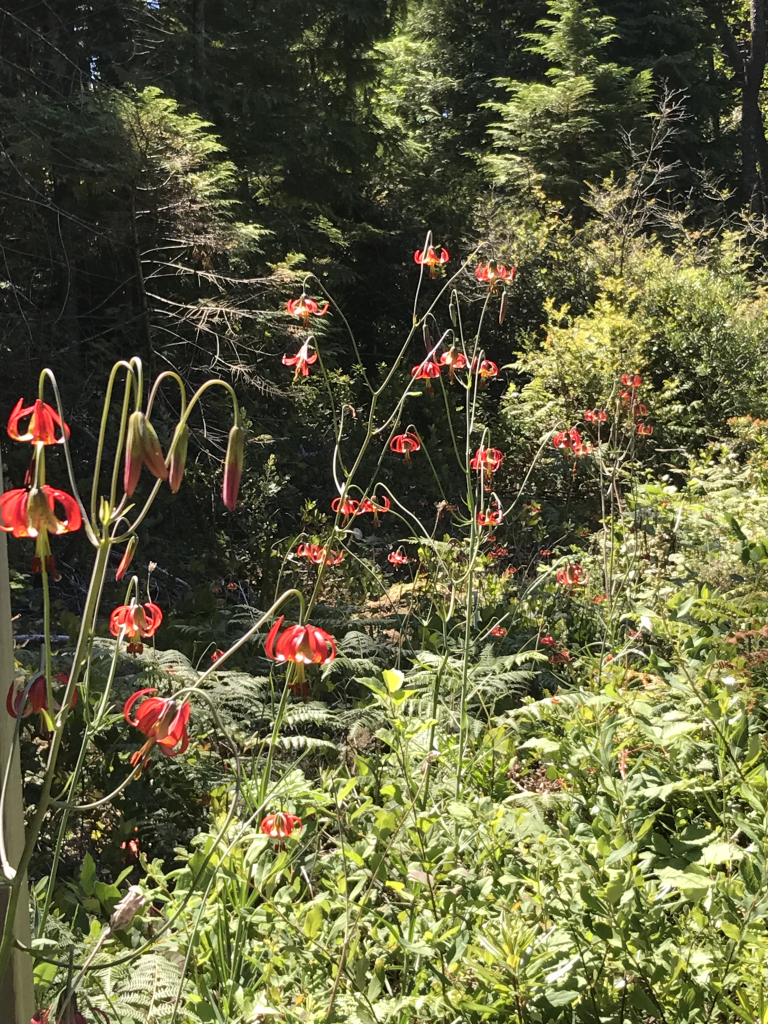
 L. occidentale in natural habitat (Hansen).
Typical or classic L. occidentale (Hansen)

Typical or classic L. occidentale (Hansen)!
Natural
Population of L. occidentale in natural habitat (Hansen)

Strange phenotype, possibly a natural hybrid (Hansen)

A large specimen hidden behind Sitka spruce (Hansen)

Large specimen in Sitka spruce stand (Hansen)
Typical classic L. occidentale (Hansen)

natural L. occidentale x L. columbianum hybrid (Hansen)